Best Biometric Time Clocks of 2026

* We independently evaluate all recommended products and services. If you click on links we provide, we may receive compensation.
Biometric time clocks are an innovative technology that has revolutionized the way businesses track employee attendance and timekeeping. These clocks use unique physical characteristics, such as fingerprints or facial recognition, to accurately identify employees and record their work hours. Biometric time clocks provide a more secure and efficient way of tracking employee attendance, eliminating the need for traditional time cards or manual entry. With the ability to integrate with payroll systems and generate detailed reports, biometric time clocks offer a convenient and reliable solution for businesses of all sizes.
At a Glance: Our Top Picks
 #TOP 1
 9.9
9.9
 #TOP 2
9.8
#TOP 2
9.8
 #TOP 3
9.6
#TOP 3
9.6
Top 7 Biometric Time Clocks
uAttend JR2000
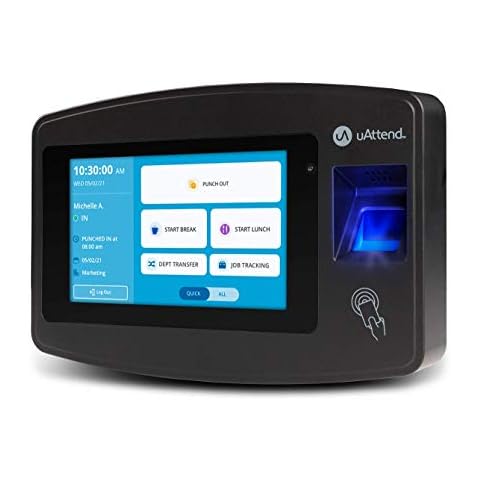
The uAttend Time Clock is a cloud-connected touchscreen time clock that offers multiple punching options in one device. With the ability to use finger scan, RFID or pin punching, this time clock caters to everyone's preferences. Even when there is no connection, uAttend's offline mode ensures that every punch is captured and synced to the system once the connection resumes. The onboarding process is simplified with the clock's ability to register and pair employee finger scans directly at the clock, eliminating the need for complicated templates. Setting up the clock is a breeze with its user-friendly touchscreen, providing menu options like department transfers and job tracking right at your fingertips. With affordable monthly cloud subscriptions starting at $25, uAttend offers lifetime replacements, one-on-one training, and unlimited customer support. Additionally, the uAttend Time Clock allows employees to access their earned wages on-demand for free with earlyPAY, setting you apart as an industry leader.
NGTeco Biometric Fingerprint Time Clock
The NGTeco Fingerprint Time Clock offers an easy way to manage employee schedules, including flexible and night shifts, by automatically calculating work hours for you. It uses fast, reliable fingerprint recognition that works even with wet or dry fingers, ensuring quick and secure access through a stable 2.4GHz WiFi connection. You can also simplify your payroll process with support for various pay cycles and easily export timesheets via email or USB. Plus, if you need to fix attendance records, the mobile app lets you edit punch entries in real time, making payroll management smooth and accurate.
HapAttend H3 Fingerprint Time Clock
The HapAttend Time Clock is a smart choice for small businesses looking to track employee hours easily and securely. Because it works without internet or WiFi, your data stays private and is stored safely on the device, which you can transfer via USB. You won’t have to worry about extra costs since this clock has no monthly fees and is ready to use right away. It automatically calculates total work hours, saving you from manual math and messy paper cards. Plus, it supports multiple languages, so you can choose the one that fits your team best, making it simple for everyone to use.
ANVIZ W1 Pro Fingerprint Time Clock

The ANVIZ W1 Pro Time Clock offers powerful cloud software that helps you easily manage employee attendance from anywhere, without needing to operate it on your own device. This software is free forever for small businesses with one admin and one device, covering most small business needs. You get versatile clock-in options like fingerprint scanning to prevent buddy punching, RFID cards, fobs, or PINs, which adds flexibility and security. Even if your internet goes down, the device works offline and saves punches until it reconnects. Plus, it automatically sends attendance data to the cloud, so you can quickly view reports and simplify payroll processing for your business.
NGTeco Fingerprint Time Clock with App

The NGTeco Fingerprint Clock offers reliable and quick biometric clock-ins, even in tough weather or busy workplaces, so you can trust accurate attendance tracking anytime. Its smart auto punch feature simplifies your work by automatically recording employee clock-ins and outs, reducing errors and saving you time. Going digital with this clock means you can ditch paper records, enjoy unlimited punches, and easily sync data through Wi-Fi to manage pay periods and reports efficiently. Plus, its built-in battery backup keeps everything running during power outages, ensuring you never lose important attendance data.
KUIIYER 3-in-1 Biometric Time Clock

The KUIIYER Biometric Time Clock offers a fast and accurate way to track employee attendance using face recognition, palm print, or PIN verification. This system makes clocking in and out effortless, identifying employees in under a second—even in low light—ensuring smooth and efficient time management. It can handle up to 1,000 users and stores a large amount of attendance data, making it perfect for small to medium businesses. The 2.8-inch color display with multi-language support and AI voice guidance helps you easily navigate and confirm identities, improving user experience. Plus, its USB data management keeps your records secure and easy to access without needing a network or app.
JIAN BOLAND T200 Time Clock with Fingerprint & Badges

The JIAN BOLAND T200 Time Clock offers a versatile way to track employee attendance using fingerprint, RFID badges, or PIN codes, making it easy for you to manage time without dealing with printer ribbons or jams. It features simple IN/OUT buttons, so you can avoid accidental duplicate punches by clearly marking when you arrive or leave. The device works independently without needing Wi-Fi or a network, allowing you to set schedules and sign-in methods for each employee with ease. You can also conveniently download attendance records in Excel format via USB, helping you keep accurate track of pay periods and employee hours.

Frequently Asked Questions (FAQs)
1. Are biometric time clocks safe?
Biometric time clocks are considered safe because they convert captured biometric data into a secure algorithm. This ensures that employees' biometric information remains protected and reduces the risk of unauthorized access or loss of control over the data.
2. Do fingerprint time clocks work?
Yes, fingerprint time clocks are effective in tracking employee attendance and improving payroll accuracy. These biometric systems offer a secure and efficient way to record employee clock-ins and outs, reducing manual data entry errors and improving the overall accuracy of payroll records.
3. What is an example of a biometric time clock?
A biometric time clock can include various types of biometric data, not just fingerprint recognition. Other examples include facial recognition and retina scans, which provide an additional level of security. Many companies prefer these biometric time clocks for their convenience, safety, and reliability in accurately tracking employee attendance.
4. Why use a biometric time clock?
Using a biometric time clock offers several benefits over traditional analog systems. It improves accuracy, efficiency, and security in tracking employee attendance. Biometric data provides a unique and reliable way to identify employees, reducing the risk of time theft and ensuring accurate payroll information across different locations.
5. How do you use a biometric time clock?
To use a biometric time clock, the supervisor must log in and create a profile for the employee. The employee's identification number is entered to enroll them in the system. The biometric option is selected, and the employee places their finger on the scanner for enrollment.
6. Can an employee legally refuse to use a biometric fingerprint time clock?
Employees have the right to refuse providing biometric scans, but employers may have policies in place regarding consent, data storage, and destruction. It is important for businesses to be aware of the laws in their state and establish appropriate policies. Employers may have the right to terminate employees who refuse to use biometric time clocks.
7. What is a main disadvantage of using biometric security?
One disadvantage of biometric security is the potential for data breaches. Although biometric databases are designed to be secure, there is still a risk of hacking. Additionally, biometric devices like facial recognition systems can raise privacy concerns for users. Advanced machine learning and algorithms are needed to minimize biases related to biometric demographic data.
8. What are the benefits of biometric time clock?
Biometric time clocks offer several benefits, such as capturing unique biological traits for employee identification, ensuring accurate employee clock-ins, preventing buddy punching practices, and eliminating time theft through biometric fingerprint reading.
9. What are the 3 types of biometric examples?
There are several types of biometric examples, including voice recognition, fingerprint scanning, facial recognition, iris recognition, and heart-rate sensors. These biometric technologies provide unique ways to identify individuals based on their biological traits.
10. What are 3 examples of biometrics?
Examples of biometrics include fingerprints, face recognition, iris, palm, and DNA-based recognition. Multimodal biometrics, which combine multiple biometric sources, can enhance security and accuracy in identification processes.
During our biometric time clock research, we found 24 biometric time clock products and shortlisted 7 quality products. We collected and analyzed 6,252 customer reviews through our big data system to write the biometric time clocks list. We found that most customers choose biometric time clocks with an average price of $145.18.
The biometric time clocks are available for purchase. We have researched hundreds of brands and picked the top brands of biometric time clocks, including uAttend, NGTeco, HapAttend, ANVIZ, KUIIYER. The seller of top 1 product has received honest feedback from 79 consumers with an average rating of 4.6.
Rebecca Cantu grew up in a family-owned retail store for home and kitchen products. She worked online and gave assistance to people to buy ideal products for their sweet home after graduating from Northwestern University with a marketing degree. She has been writing content for online shopping guides since 2011 with her professional knowledge and natural sensitivity of appliances.