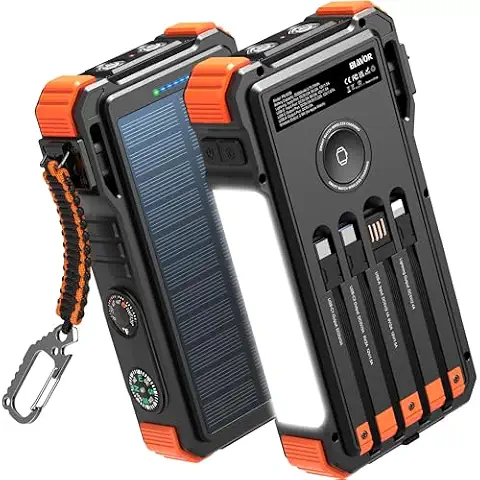
The Right Solar Charger Power Banks for You
Solar power banks are a convenient and eco-friendly way to charge your electronic devices on the go. With a solar charger power bank, you can harness the power of the sun to keep your phone, tablet, and other gadgets charged up and ready to use, even when you're far from an electrical outlet. But with so many solar charger power banks on the market, it can be difficult to know which one to choose. Here are some things to consider when shopping for a solar charger power bank.
Capacity
One of the most important factors to consider when choosing a solar charger power bank is its capacity, measured in milliampere-hours (mAh). The higher the mAh, the more charge the power bank can hold, and the more charges it can provide for your devices. A power bank with a capacity of 10,000 mAh or more is recommended for most users.
Solar Panel
The efficiency of a solar charger power bank's solar panel is another important factor to consider. A more efficient solar panel will be able to generate more power in the same amount of time, allowing the power bank to charge faster. Look for a power bank with a high-efficiency solar panel, preferably one that has been certified by a reputable organization like the International Electrotechnical Commission (IEC).
Size and Weight
When you're on the go, you want a solar charger power bank that is portable and easy to carry. Look for a power bank that is small and lightweight, so you can easily slip it into your backpack or purse. At the same time, make sure the power bank is large enough to hold a sufficient amount of charge to meet your needs.
USB Output
Most solar charger power banks have at least one USB output, which allows you to charge your devices by plugging in a charging cable. Some power banks have multiple USB outputs, so you can charge multiple devices at the same time. Consider how many devices you need to charge and how many USB outputs you'll need on your solar charger power bank.
Additional Features
Some solar charger power banks come with additional features that can be useful in certain situations. For example, some power banks have built-in LED flashlights, which can be handy in case of an emergency. Other power banks have built-in cables, so you don't have to carry a separate charging cable with you. Consider whether these additional features are worth the extra cost for your needs.
Price
Solar charger power banks can vary greatly in price, from less than $20 to over $100. In general, you get what you pay for when it comes to solar charger power banks. Cheaper power banks may not have as high of a capacity or as efficient of a solar panel, and they may not last as long. On the other hand, more expensive power banks may have more features and be more durable, but they may not be worth the extra cost if you don't need those features.
Brand
Finally, consider the brand of the solar charger power bank you're considering. Some brands are known for their high-quality products, while others are known for their low prices. Do some research and read customer reviews to get a sense of which brands are reputable and which ones to avoid.
In conclusion, choosing the right solar charger power bank involves considering a number of factors, including capacity, solar panel efficiency, size and weight, USB output, additional features, price, and brand. By taking the time to carefully consider these factors, you can find a solar charger power bank that meets your needs and provides reliable, eco-friendly power on the go.
Frequently Asked Questions (FAQs)
1. Do solar charger power banks work?
Yes, solar charger power banks work by storing solar energy they absorb from sunlight in the form of chemical energy. This energy is then converted to electrical energy as needed, making them a reliable power source for situations when access to an outlet is limited or unavailable.
2. What is the disadvantage of solar power bank?
One disadvantage of solar power banks is the high initial cost for materials and installation. Additionally, they require a significant amount of space as their efficiency is not 100% yet. Another limitation is that solar power banks do not generate solar power at night, so a large battery bank is needed for storing energy.
3. Is a solar portable charger worth it?
Yes, a solar portable charger is worth it as it provides a way to generate usable power in unpredictable situations. As long as there is available sunlight, portable solar chargers can be used to generate power, making them useful during emergencies or when you're spending extended periods outdoors.
4. What does a solar charger do when the battery is full?
When a solar charger's battery reaches full charge, the inverter and charge controller step in to handle excess power. They can either push it back into the panels for power loss, back into the grid for credits, or force a dump load to prevent overcharging and mitigate risks.
5. What is the difference between a solar charger and a solar power bank?
The main difference between a solar charger and a solar power bank is their size and portability. Solar chargers are typically larger and less portable compared to power banks. Additionally, solar chargers require direct sunlight to work and will not function at night, on rainy days, or in areas with limited sunlight.
6. How long do solar battery banks last?
The lifespan of a solar battery bank can vary depending on the type of battery. Residential solar battery units can last anywhere between five to fifteen years. Gel batteries usually last around 1100 cycles, lithium-ion phosphate batteries last approximately 7000 cycles, and absorbed glass batteries last about 600 cycles.
7. What should I look for in a solar power bank?
When looking for a solar power bank, it is important to consider its capacity rating. This rating indicates how long the power bank will last on a single charge. Look for capacity ratings such as 20000 mAh, 30000 mAh, or higher to ensure you have enough power for your needs.
8. What is the biggest drawback to solar power?
The biggest drawbacks of solar power include the high initial costs of installing panels, the expense of solar energy storage, limitations based on roof types, and the dependence on sunlight for solar panels to generate power.