Best Epistemology Philosophy Books of 2026

* We independently evaluate all recommended products and services. If you click on links we provide, we may receive compensation.
Epistemology philosophy books are a must-have for anyone interested in exploring the nature of knowledge and belief. These books delve into questions such as: What is knowledge? How do we acquire it? Can we trust our senses? The authors of these books draw from a wide range of philosophical traditions, including empiricism, rationalism, and skepticism. Some notable titles include "An Essay Concerning Human Understanding" by John Locke, "Meditations on First Philosophy" by René Descartes, and "The Problems of Philosophy" by Bertrand Russell. Whether you're a student of philosophy or simply curious about the nature of knowledge, these books provide a fascinating and thought-provoking read.
At a Glance: Our Top Picks
 #TOP 1
 9.9
9.9
 #TOP 2
9.8
#TOP 2
9.8
 #TOP 3
9.6
#TOP 3
9.6
Top 10 Epistemology Philosophy Books
Made to Stick: Why Some Ideas Survive and Others Die
Made to Stick by Chip and Dan Heath is a New York Times bestseller that explores why some ideas thrive while others die. The book offers practical ways to make ideas stickier and draws on real-life examples to explain how to apply the six traits of sticky messages. The authors reveal the anatomy of ideas that stick and explain how to create curiosity gaps and apply the human scale principle to make messages memorable. Made to Stick is a must-read for anyone interested in effective communication and offers a fast-paced tour of success stories and failures that transform the way we communicate.
Beyond Good and Evil
Beyond Good and Evil: Prelude to a Philosophy of the Future is a critical and polemical work by Friedrich Nietzsche, first published in 1886. In the book, Nietzsche accuses past philosophers of lacking critical sense and blindly accepting dogmatic premises in their consideration of morality. The work moves beyond traditional morality and offers an affirmative approach that fearlessly confronts the perspectival nature of knowledge and the perilous condition of the modern individual. This book is a must-read for anyone interested in philosophy and critical thinking.
The Voice of Knowledge: A Practical Guide to Inner Peace
From the bestselling author of The Four Agreements. In The Voice of Knowledge, Miguel Ruiz reminds us of a profound and simple truth: The only way to end our emotional suffering and restore our joy in living is to stop believing in lies — mainly about ourselves. Based on ancient Toltec wisdom, this breakthrough book shows us how to recover our faith in the truth and return to our own common sense. . Ruiz changes the way we perceive ourselves, and the way we perceive other people. Then he opens the door to a reality that we once perceived when we were one and two years old — a reality of truth, love, and joy.. "We are born in truth, but we grow up believing in lies. . . . One of the biggest lies in the story of humanity is the lie of our imperfection." — don Miguel Ruiz
The Matter With Things: Our Brains, Our Delusions, and the Unmaking of the World

In this landmark new book, Iain McGilchrist addresses some of the oldest and hardest questions humanity faces – ones that, however, have a practical urgency for all of us today. Who are we? What is the world? How can we understand consciousness, matter, space and time? Is the cosmos without purpose or value? Can we really neglect the sacred and divine?In doing so, he argues that we have become enslaved to an account of things dominated by the brain’s left hemisphere, one that blinds us to an awe-inspiring reality that is all around us, had we but eyes to see it. He suggests that in order to understand ourselves and the world we need science and intuition, reason and imagination, not just one or two; that they are in any case far from being in conflict; and that the brain’s right hemisphere plays the most important part in each. And he shows us how to recognise the ‘signature’ of the left hemisphere in our thinking, so as to avoid making decisions that bring disaster in their wake.Following the paths of cutting-edge neurology, philosophy and physics, he reveals how each leads us to a similar vision of the world, one that is both profound and beautiful – and happens to be in line with the deepest traditions of human wisdom. It is a vision that returns the world to life, and us to a better way of living in it: one we must embrace if we are to survive.
Knowledge And Decisions

With a new preface by the author, this reissue of Thomas Sowell's classic study of decision making updates his seminal work in the context of The Vision of the Annointed, Sowell, one of America's most celebrated public intellectuals, describes in concrete detail how knowledge is shared and disseminated throughout modern society. He warns that society suffers from an ever-widening gap between firsthand knowledge and decision making—a gap that threatens not only our economic and political efficiency, but our very freedom because actual knowledge gets replaced by assumptions based on an abstract and elitist social vision f what ought to be.Knowledge and Decisions, a winner of the 1980 Law and Economics Center Prize, was heralded as a ”landmark work” and selected for this prize ”because of its cogent contribution to our understanding of the differences between the market process and the process of government.” In announcing the award, the center acclaimed Sowell, whose ”contribution to our understanding of the process of regulation alone would make the book important, but in reemphasizing the diversity and efficiency that the market makes possible, [his] work goes deeper and becomes even more significant.”
CDC Yellow Book 2024: Health Information for International Travel (CDC Health Information for International Travel)

The CDC Yellow Book 2024: Health Information for International Travel is a comprehensive reference text that has been a trusted resource for over half a century. It provides expert guidance for safe and healthy travel abroad, including disease-specific prevention and treatment recommendations and background information on health threats associated with international travel. The latest edition features updates on practicing travel medicine in a virtual environment, guidelines for self-treating common travel conditions, and expanded content on safe international travel for specific groups. It also includes country-specific recommendations for mosquito avoidance, yellow fever vaccine, and malaria prevention. This book is a must-have for anyone planning to travel internationally.
The One: How an Ancient Idea Holds the Future of Physics

The One: How an Ancient Idea Holds the Future of Physics takes readers on a journey through the history of monism, the belief that everything in the universe is part of one unified whole. Particle physicist Heinrich Päs argues that monism could inspire modern physics and help achieve the grand theory of everything. The book blends physics, philosophy, and history to present an epic and mind-expanding exploration of the nature of reality. The research is thorough, the physics is cutting-edge, and the larger point that much of reality is an artifact of our limited perspectives is thought-provoking. Overall, The One is an original and enlightening read for anyone seeking to understand their place in nature.
The Death of Expertise: The Campaign against Established Knowledge and Why it Matters
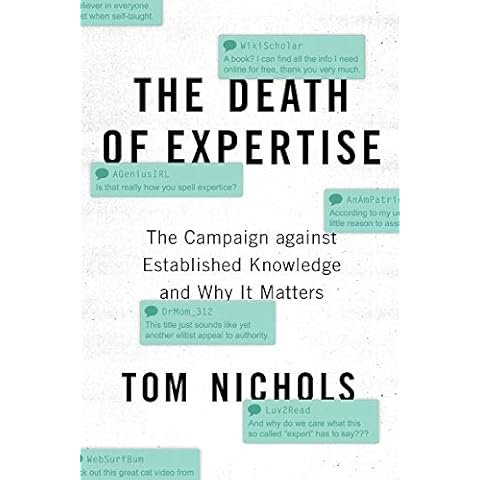
The Death of Expertise by Tom Nichols explores how the rise of technology and increased access to information has led to a rejection of experts and established knowledge. Nichols argues that this rejection has resulted in an ill-informed and angry citizenry that threatens the stability of democracy. The paperback edition includes a new foreword that addresses the exacerbation of these trends in the aftermath of Donald Trump's election. This book is an important warning about the dangers of populist and technocratic tendencies in our society.
The Black Swan: The Impact of the Highly Improbable (Incerto)

The most influential book of the past seventy-five years: a groundbreaking exploration of everything we know about what we don’t know, now with a new section called “On Robustness and Fragility.”. A black swan is a highly improbable event with three principal characteristics: It is unpredictable; it carries a massive impact; and, after the fact, we concoct an explanation that makes it appear less random, and more predictable, than it was. The astonishing success of Google was a black swan; so was 9/11. For Nassim Nicholas Taleb, black swans underlie almost everything about our world, from the rise of religions to events in our own personal lives. Why do we not acknowledge the phenomenon of black swans until after they occur? Part of the answer, according to Taleb, is that humans are hardwired to learn specifics when they should be focused on generalities. We concentrate on things we already know and time and time again fail to take into consideration what we don’t know. We are, therefore, unable to truly estimate opportunities, too vulnerable to the impulse to simplify, narrate, and categorize, and not open enough to rewarding those who can imagine the “impossible.” For years, Taleb has studied how we fool ourselves into thinking we know more than we actually do. We restrict our thinking to the irrelevant and inconsequential, while large events continue to surprise us and shape our world. In this revelatory book, Taleb will change the way you look at the world, and this second edition features a new philosophical and empirical essay, “On Robustness and Fragility,” which offers tools to navigate and exploit a Black Swan world.. Taleb is a vastly entertaining writer, with wit, irreverence, and unusual stories to tell. He has a polymathic command of subjects ranging from cognitive science to business to probability theory. Elegant, startling, and universal in its applications, The Black Swan is a landmark book—itself a black swan.
The Art of Happiness (Penguin Classics)

The brilliant writings of a highly influential Greek philosopher, with a foreword by Daniel Klein, author of Travels with EpicurusThe teachings of Epicurus—about life and death, religion and science, physical sensation, happiness, morality, and friendship—attracted legions of adherents throughout the ancient Mediterranean world and deeply influenced later European thought. Though Epicurus faced hostile opposition for centuries after his death, he counts among his many admirers Thomas Hobbes, Thomas Jefferson, Karl Marx, and Isaac Newton. This volume includes all of his extant writings—his letters, doctrines, and Vatican sayings—alongside parallel passages from the greatest exponent of his philosophy, Lucretius, extracts from Diogenes Laertius' Life of Epicurus, a lucid introductory essay about Epicurean philosophy, and a foreword by Daniel Klein, author of Travels with Epicurus and coauthor of the New York Times bestseller Plato and a Platypus Walk into a Bar.. For more than sixty-five years, Penguin has been the leading publisher of classic literature in the English-speaking world. With more than 1,500 titles, Penguin Classics represents a global bookshelf of the best works throughout history and across genres and disciplines. Readers trust the series to provide authoritative texts enhanced by introductions and notes by distinguished scholars and contemporary authors, as well as up-to-date translations by award-winning translators.

Frequently Asked Questions (FAQs)
1. What is an example of epistemology philosophy?
An example of epistemology is a thesis paper on the source of knowledge. noun. 15. 3. (uncountable) The branch of philosophy dealing with the study of knowledge; theory of knowledge, asking such questions as "What is knowledge?", "How is knowledge acquired?", "What do people know?", "How do we know what we know?".
2. Who wrote the book about epistemology?
Epistemology: A Contemporary Introduction to the Theory of Knowledge, 3rd Edition: Audi, Robert: 9780415879231: Books.
During our epistemology philosophy book research, we found 1,000+ epistemology philosophy book products and shortlisted 10 quality products. We collected and analyzed 33,824 customer reviews through our big data system to write the epistemology philosophy books list. We found that most customers choose epistemology philosophy books with an average price of $12.09.
Wilson Cook is a talented writer who has an MFA in creative writing from Williams College and has published more than 50 books acquired by hundreds of thousands of people from various countries by now. He is an inveterate reading lover as he has read a vast amount of books since childhood.