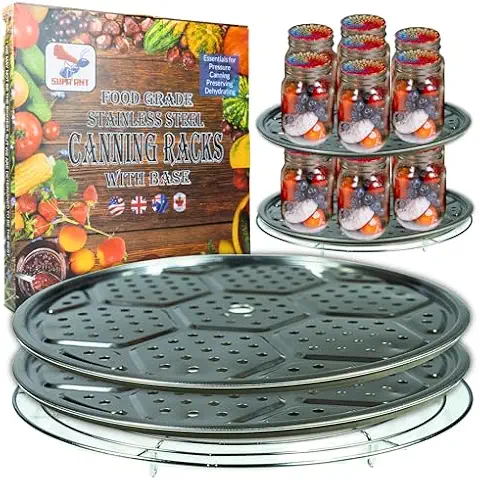
Choosing the Best Canning Racks to Build Your Dream Home
The Importance of Choosing the Right Canning Rack
Canning is a time-honored tradition that allows individuals to preserve food for long periods of time. This practice is not only useful for ensuring that you have access to fresh, healthy food all year round, but it can also save you money by reducing food waste.
One of the key tools for successful canning is the canning rack. This device is used to hold the jars of food in place during the canning process, allowing for even heating and ensuring that the jars are properly sealed.
But with so many different types of canning racks on the market, how do you choose the right one for your needs? Here are some key factors to consider when making your decision.
Size and Capacity
One of the most important things to consider when choosing a canning rack is the size and capacity. Canning racks come in a variety of sizes, and you need to choose one that is appropriate for the amount of food you plan to preserve.
If you only plan to preserve a small amount of food at a time, a smaller canning rack will be sufficient. However, if you have a large garden or plan to preserve large quantities of food, you will need a larger canning rack to accommodate all of your jars.
It's also important to consider the size of your canning pot or pressure canner. You want to choose a canning rack that will fit comfortably inside your canning pot, without leaving too much space around the edges.
Material
Another important factor to consider when choosing a canning rack is the material it is made from. Canning racks are typically made from either metal or plastic, and each has its own advantages and disadvantages.
Metal canning racks are typically more durable and long-lasting than plastic racks. They are also less likely to warp or melt when exposed to high temperatures. However, metal canning racks can be more difficult to clean and may be more expensive than plastic racks.
Plastic canning racks are generally less expensive than metal racks and are also easier to clean. However, they are not as durable and may not be able to withstand high temperatures as well as metal racks.
Design and Features
In addition to size and material, you also want to consider the design and features of the canning rack you choose. Some canning racks have features that make the canning process easier, such as handles for easy lifting, or built-in drip channels to prevent spills.
You also want to choose a canning rack that is easy to use and will hold your jars securely in place. Look for racks that have sturdy, well-spaced bars or slots to hold the jars, and make sure they are spaced appropriately for the size of your jars.
Price
Finally, you will want to consider the price of the canning rack when making your decision. Canning racks can vary widely in price, depending on their size, material, and features.
While it may be tempting to choose the cheapest option, it's important to remember that a good quality canning rack is an investment that will pay off in the long run. A well-made, durable canning rack will last for many seasons and make the canning process easier and more efficient.
In conclusion, choosing the right canning rack is an important step in the canning process. By considering factors such as size, material, design, and price, you can choose a canning rack that will meet your needs and help you successfully preserve your food.
Frequently Asked Questions (FAQs)
1. Is a canning rack necessary?
Yes, a canning rack is necessary for proper canning. It ensures that the jars are slightly elevated, preventing them from being too close to the heating element of the stovetop. It also allows the boiling water to come into contact with all surfaces of the jar without entering the jar itself.
2. Can I use a towel instead of a canning rack?
No, it is not recommended to use a towel instead of a canning rack. A towel will interfere with the transfer of heat into the jars and restrict the circulation of water under the jars. It is important to use a proper canning rack to ensure effective heat distribution and sterilization.
3. Why do you put jars upside down when canning?
Putting jars upside down after canning is known as inversion canning. It is done to create a vacuum and sterilize the seal. By allowing hot food to come into contact with the seal and allowing air to escape, a vacuum is created, ensuring the preservation of the canned food.
4. Can I do water bath canning without a rack?
No, when performing water bath canning, it is necessary to use a rack to elevate the jars off the bottom of the pot. This allows for proper heat distribution and prevents the jars from direct contact with the bottom, reducing the risk of breakage.
5. Is aluminum or stainless steel better for canning?
Both aluminum and stainless steel canning racks have their advantages. Aluminum is a good choice as it transfers heat efficiently, is lightweight, inexpensive, and rust-free. Stainless steel is another popular choice as it is virtually rust-free. However, it is a poor and uneven heat conductor.
6. How do I keep my canning rack from rusting?
To prevent rusting, it is important to limit contact with water or moisture. Make sure to empty and clean your canner and drying rack promptly after use to avoid prolonged exposure to moisture.
7. Do jars need to be completely covered with water when canning?
Yes, jars need to be completely submerged under at least 3 to 5 cm (one to two inches) of water during canning. This allows air to escape from the jars and prevents it from re-entering after sealing. Ensuring complete water coverage promotes proper sealing and preservation of the canned food.