
Skip to content
Fitness & Gear

Verified & updated:

Snowboard Size Chart & Wide-Board Calculator

Calculate your ideal snowboard length range by weight first (cross-checked against height, skill, and terrain) and check immediately whether your boot size needs a Standard, Mid-Wide, or Wide waist width.

Weight-first snowboard sizing · Boot size sets waist width

lbs
ft
in
Boot size system
US M
Riding ability
Primary terrain

Recommended Snowboard Length

155–160 cm

Standard Width

Standard waist width (246–254 mm) fits US M 10.0 / EU 43 boots cleanly with agile edge-to-edge quickness.

155–160 cm 246–254 mm Target Waist Width

Sweet Spot

157 cm

Waist Width

246–254 mm

Width Tier

Standard Width

Reference Stance

54 cm (21.3")

Snowboard Length & Waist Width Reference Charts

Modern snowboard flex cores are engineered around rider weight rather than chin height. Use your weight band for length and your boot size for waist width.

Rider Weight Park / Freestyle All-Mountain Freeride / Powder
90–110 lbs (41–50 kg) 136–142 cm 138–144 cm 142–147 cm
110–130 lbs (50–59 kg) 142–148 cm 144–150 cm 147–153 cm
130–150 lbs (59–68 kg) 146–152 cm 149–155 cm 152–158 cm
150–170 lbs (68–77 kg) 150–156 cm 153–159 cm 156–162 cm
170–190 lbs (77–86 kg) 154–159 cm 156–162 cm 159–165 cm
190–210 lbs (86–95 kg) 156–162 cm 159–165 cm 162–168 cm
210–230 lbs (95–104 kg) 159–164 cm 161–167 cm 164–170 cm
230+ lbs (104+ kg) 162–166 cm 164–170 cm 166–172+ cm
US Men Boot EU Boot Waist Width Board Width
7–8.5 40–41.5 244–250 mm Standard
9–10 42–43 250–255 mm Standard
10.5–11 43.5–44 255–261 mm Mid-Wide
11.5–12.5 44.5–45.5 262–268 mm Wide (W)
13+ 46+ 268–275+ mm Ultra-Wide

At a glance: a 165 lb (75 kg) intermediate all-mountain rider typically fits a 155–160 cm board; riders wearing US Men’s 10.5–11 (EU 43.5–44) benefit from a Mid-Wide (255–261 mm) waist, while US Men’s 11.5+ (EU 44.5+) riders need a dedicated Wide (262+ mm) deck.

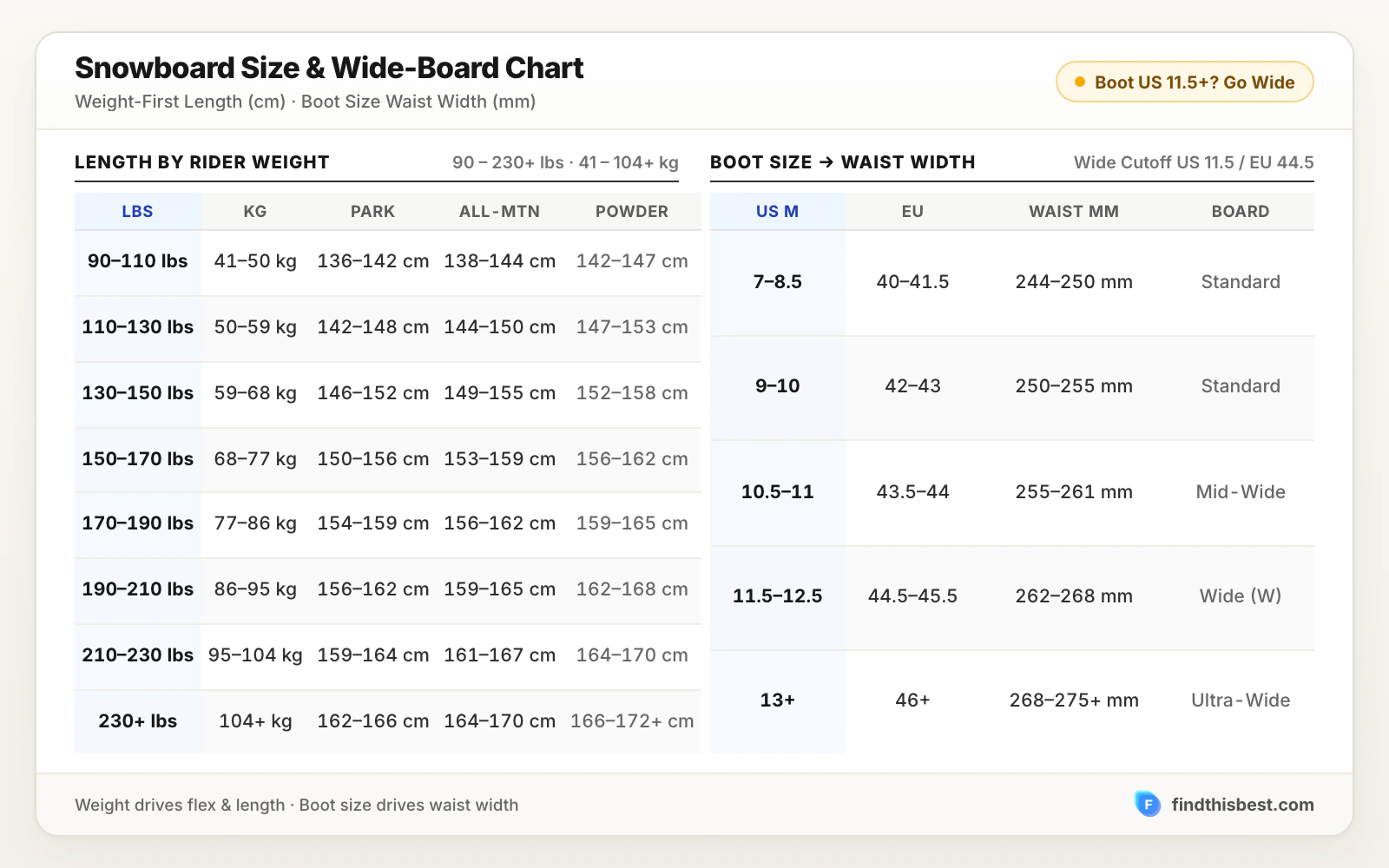
Quick-reference chart image

Snowboard Size & Wide-Board Chart

Weight-first snowboard length chart and boot-size waist-width cutoff reference.

Download PNG

Why Weight Matters More Than Chin Height on Modern Snowboards

The old "stand the board between your chin and nose" shortcut ignores how snowboard cores actually flex. A board does not know how tall you are—it only feels the downward weight pressing its camber and effective edge into snow.

Always check the specific manufacturer’s recommended rider weight range printed on the spec sheet. If you are tall and light, lean toward the shorter end of your height bracket so you can still bend the board; if you are shorter and heavier, size up within your weight range for edge stability.

When Do You Need a Mid-Wide or Wide Snowboard?

Toe and heel drag happen when your boots overhang the metal edges far enough to dig into snow during hard turns, throwing you off balance. Aim for roughly 1–2 cm (½–¾ inch) of boot overhang on each side—not more.

  • US Men’s 10 and under (EU ≤ 43): Standard widths (246–254 mm) transition quickest edge to edge.
  • US Men’s 10.5–11 (EU 43.5–44): Look for Mid-Wide (255–261 mm) waists or reduced-footprint boots.
  • US Men’s 11.5 and up (EU 44.5+): Choose a dedicated Wide (262+ mm) deck or volume-shifted wide chassis.

Adjusting Length for Park, All-Mountain, Powder & Volume-Shifted Boards

Park & Freestyle (−2 to −4 cm)

Shorter twin boards lower swing weight for spins, rails, and presses while staying nimble at slower speeds.

Freeride & Deep Powder (+2 to +5 cm)

Longer directional decks increase surface area for float in deep snow and damp chatter on steep, fast descents.

Volume-Shifted Short-Wide Boards (−5 to −8 cm)

Modern short-wide shapes (such as the Ride Warpig or Burton Family Tree) pack extra width into a shorter outline—always follow the brand’s specific volume-shifted weight chart.

Beginner Learning Curves (−2 cm)

Choosing the shorter end of your weight bracket makes linking heel-to-toe turns significantly less tiring on your first two seasons.

Frequently asked questions

Always prioritize rider weight first, then use height only as a secondary cross-check (±2–3 cm). Weight determines how well you flex the camber and engage the edges.

How this works

Board length recommendations interpolate standard industry rider-weight curves (evo / Burton weight brackets), bounded by a ±3 cm height cross-check, skill/terrain offsets, and boot-size waist-width thresholds (10.5–11 US Mid-Wide, 11.5+ US Wide).

Sources & standards

More Fitness & Gear tools

All tools

Related tools