
Skip to content
Kitchen

Verified & updated:

Meat Cuts & Safe Internal Temperature Visual Guide

Filter 16 everyday meat and seafood cuts by animal or cooking method, click any cut to inspect its USDA safe minimum, pull-off temperature, carryover rise, resting window, and numbered visual cues — plus download a printable 16:10 reference chart.

Showing 16 of 16 cuts
Ribeye Steak
Illustrative culinary guide
Chef target (below USDA 145 °F)

Ribeye Steak

Rich marbling · High-heat sear or grill

Target doneness / stage

Pull off heat

130 °F

130 °F (54 °C)

Final target

135 °F

Medium-Rare

USDA safe min

145 °F

145 °F (63 °C)

Rest & carryover

5–10 min

+5 °F

Thermal safety scale USDA 145 °F
135 °F 110 °F USDA 145 °F 215 °F
Red marks temperatures below the official USDA FSIS minimum for this cut. Amber bridges pull-off to rested target temperature.

Selected chef target (135 °F (57 °C)) sits below the official USDA minimum (145 °F (63 °C)). Suitable only for intact whole-muscle cuts with seared exteriors; serve higher-risk guests at or above the USDA floor.

Visual & probe cues

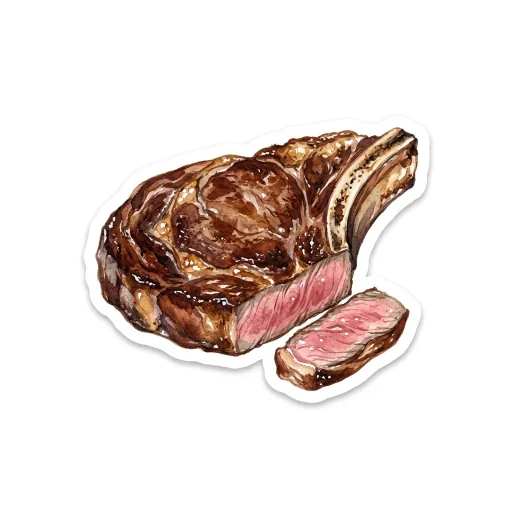
  1. 1 Deep mahogany crust with rendered golden fat along the outer cap.
  2. 2 Warm rosy-pink center at 130–135 °F (54–57 °C) melts intramuscular marbling cleanly.
  3. 3 Rest 5–10 minutes on a warm board so carryover (+5 °F / 3 °C) sets without losing juices.

At a glance

Probe placement
Insert horizontally from the side into the center of the main eye, avoiding the rib bone and large fat cap.
Best methods
Grill & Sear
Rest window
5–10 min

Complete 16-cut safe internal temperature reference table

Every cut in our visual guide side-by-side with its default chef pull-off temperature, final rested target, official USDA FSIS minimum, and recommended resting time.

Cut Category Pull Off Heat Final Target USDA Min & Rest
Ribeye Steak Beef 130 °F 135 °F · Medium-Rare 145 °F (63 °C) · 5–10 min rest
Filet Mignon Beef 127 °F 132 °F · Medium-Rare 145 °F (63 °C) · 5–8 min rest
Beef Brisket Beef 200 °F 203 °F · Slice Tender 145 °F (63 °C) · 60–120 min rest
Chuck Roast Beef 202 °F 205 °F · Fork / Shred Tender 145 °F (63 °C) · 20–30 min rest
Ground Beef Patty Beef 160 °F 160 °F · USDA Safe Min 160 °F (71 °C) · 3–5 min rest
Pork Chop Pork 140 °F 145 °F · Medium 145 °F (63 °C) · 3–5 min rest
Pork Tenderloin Pork 140 °F 145 °F · Medium 145 °F (63 °C) · 5 min rest
Pork Shoulder (Boston Butt) Pork 200 °F 203 °F · Fork / Shred Tender 145 °F (63 °C) · 45–60 min rest
Pork Ribs (Baby Back & Spare) Pork 193 °F 195 °F · Clean Bite-Off 145 °F (63 °C) · 15–20 min rest
Chicken Breast Poultry 160 °F 165 °F · USDA Safe Min 165 °F (74 °C) · 5 min rest
Chicken Thigh Poultry 175 °F 180 °F · Tender Dark Meat 165 °F (74 °C) · 5 min rest
Whole Roast Turkey Poultry 158 °F 165 °F · Breast Safe 165 °F (74 °C) · 25–40 min rest
Duck Breast (Magret) Poultry 130 °F 135 °F · Medium-Rare 165 °F (74 °C) · 5–8 min rest
Rack of Lamb Lamb & Seafood 126 °F 132 °F · Medium-Rare 145 °F (63 °C) · 8–10 min rest
Salmon Fillet Lamb & Seafood 124 °F 128 °F · Moist & Flaky 145 °F (63 °C) · 2–3 min rest
Shrimp / Prawns Lamb & Seafood 122 °F 125 °F · Just Opaque 145 °F (63 °C) · 1–2 min rest

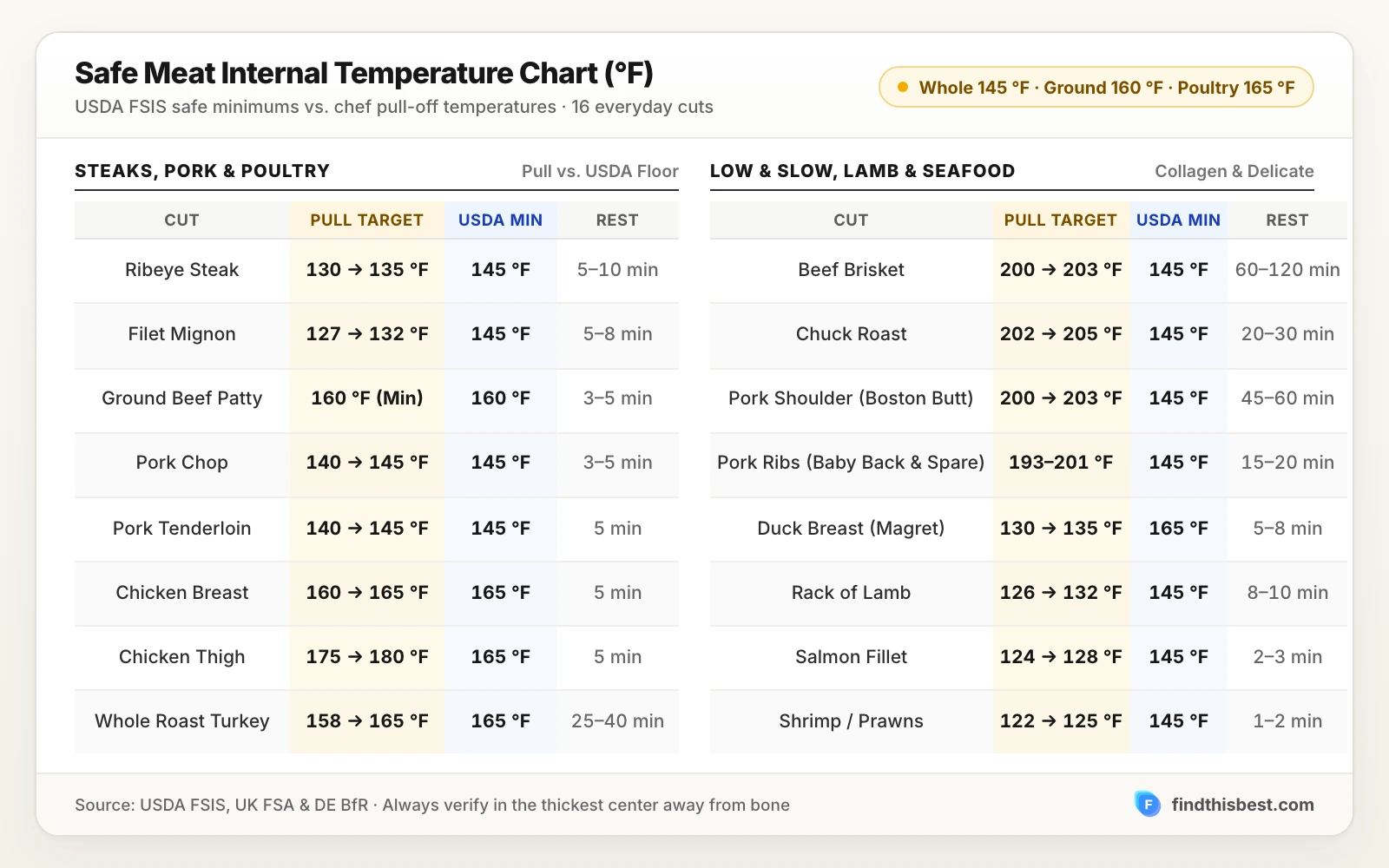
Quick-reference chart image

Safe Meat Internal Temperature Chart (°F)

Quick-reference 16-cut meat temperature chart showing recommended pull-off temperatures, official USDA FSIS safe minimums, and rest times.

Download PNG

Where to insert a digital thermometer for an accurate reading

Even the fastest instant-read thermometer can read 15–25 °F (8–14 °C) off if the sensor tip sits too close to a bone, pan surface, or thin outer crust. Because bone conducts heat differently and pan bottoms run much hotter than meat centers, probe geometry matters as much as probe speed.

  1. 01. Locate the thickest geometric center of the cut — for thin steaks, pork chops, chicken breasts, and burgers, insert the probe horizontally through the side edge rather than vertically from the top.
  2. 02. Stop cleanly clear of bones, gristle, and thick surface fat caps; on whole poultry, check the thickest breast lobe plus the innermost thigh and wing joints.
  3. 03. Slowly pull the probe back out a few millimeters while watching the readout: the lowest temperature you see in the middle is the true core temperature.

Carryover cooking and resting: why you pull meat 5 °F early

When you lift a steak, roast, or holiday turkey off high heat, the outer crust is still 250–400 °F (120–200 °C) while the center is far cooler. Thermal energy continues flowing inward for several minutes after leaving the pan or oven — a predictable climb called carryover cooking.

Ignoring carryover is the #1 reason steaks turn medium-well and chicken breasts turn dry. Small pan-seared cuts typically climb 3–5 °F (2–3 °C); dense standing roasts and whole turkeys climb 8–12 °F (4–6 °C) over 25–40 minutes.

Why whole steaks can be pink while ground beef and poultry cannot

Food-safety minimums follow meat microbiology rather than personal taste:

  • Intact whole-muscle beef & lamb: Harmful surface pathogens sit on the exterior of solid muscle. High-heat searing sterilizes the outside instantly, which is why chefs safely serve medium-rare steaks while USDA lists 145 °F (63 °C) + 3-minute rest for maximum margin.
  • Ground meat (burgers, meatballs, sausage): Grinding folds exterior surface bacteria throughout the entire interior. Cooking strictly to 160 °F (71 °C) (or 165 °F / 74 °C for ground poultry) eliminates interior risk.
  • Poultry (chicken & turkey): Salmonella and Campylobacter can penetrate porous poultry tissue and joint cavities, requiring 165 °F (74 °C) instantaneous core heat (or 70 °C held for 2 minutes under UK FSA / German BfR pasteurization curves).
  • Low-and-slow barbecue cuts: Brisket, chuck roast, pork shoulder, and ribs pass the USDA safety threshold hours before they are pleasant to eat — collagen only converts into silky gelatin between 195 and 205 °F (91–96 °C).

US USDA vs. UK FSA and European (German BfR) temperature standards

Temperature charts differ slightly across the Atlantic because European food agencies express thermal pasteurization as temperature plus holding time, whereas USDA publishes simpler instantaneous targets:

Official safe core temperature comparison: US USDA FSIS vs. UK FSA vs. German BfR
Category US (USDA FSIS) UK (FSA) Germany / EU (BfR)
Whole Beef & Lamb Steaks 145 °F (63 °C) + 3 min rest Seared exterior (rare center allowed on whole cuts) Seared exterior; ≥ 63 °C for risk groups
Whole Pork Chops & Roasts 145 °F (63 °C) + 3 min rest 70 °C for 2 min (or 75 °C instant) ≥ 70 °C core for 2 min recommended
Ground / Minced Meat 160 °F (71 °C) instant 70 °C for 2 min (or 75 °C instant) ≥ 70 °C core for at least 2 min
Chicken & Turkey Poultry 165 °F (74 °C) instant 70 °C for 2 min (or 75 °C instant) ≥ 70 °C core for at least 2 min

Frequently asked questions

Yes. The USDA lowered whole-cut pork (chops, tenderloin, roasts) from 160 °F to 145 °F (63 °C) followed by a 3-minute rest in 2011. Ground pork and sausages still require 160 °F (71 °C).

How this works

All 16 cuts map directly to official USDA FSIS, UK FSA, and German BfR food-safety standards, pairing mandatory microbial safety thresholds with chef pull-off temperatures, carryover curves, and cut-specific probe cues.

Official safety floor separation
Every cut displays its statutory USDA FSIS minimum (145 °F / 63 °C whole beef/pork/lamb/seafood, 160 °F / 71 °C ground meat, 165 °F / 74 °C all poultry) independently from optional chef doneness stages, flagging any selection below the floor.
Pull-off & carryover offset
Recommended pull-off temperature subtracts cut-specific carryover rise (3–5 °F / 2–3 °C for steaks, chops & fillets; 8 °F / 4 °C for whole turkeys) from the final rested target, except strict ground patties checked at full minimum.
Fahrenheit & Celsius conversion
All °F and °C targets follow exact thermal equivalents rounded to whole degrees (°C = (°F − 32) × 5 ÷ 9), defaulting to °F on US and °C on UK, DE, FR, and ES sites.
  • High-risk diners (pregnant individuals, young children, older adults, immunocompromised guests) should always be served at or above the official USDA FSIS / FSA / BfR minimum.
  • Calibrate digital thermometers periodically in an ice-water bath (32 °F / 0 °C) for reliable readings.

Sources & standards

More Kitchen tools

All tools