
Skip to content
Sizing & Fit

Verified & updated:

Glasses & Sunglasses Size Guide (52□18-145 Decoder)

Enter the three ISO 8624 millimeter numbers printed inside your glasses arm (lens □ bridge - temple) or measure your face width to pinpoint Narrow, Medium, or Wide sunglasses and optical frames.

Check the inside of the left temple arm for three numbers such as 52□18-145.

mm
mm
mm
in

Hold a straight ruler horizontally beneath your eyes from outer temple to outer temple.

Frame material / rim thickness
mm

Recommended frame fit & front width

Medium (132 mm)

52□18-145

132 mm 52 mm Lens Width 18 mm Bridge 145 mm Temple ISO 8624 · Total width ≈ 2 × Lens + Bridge + 10 mm

Total Width

132 mm (5.20")

Lens Width

52 mm

Bridge

Standard nose bridge

Temple

Standard arm (140–145 mm)

Frame PD (A+DBL)

70 mm

Optical PD Match

Moderate decentration (Δ 7 mm)

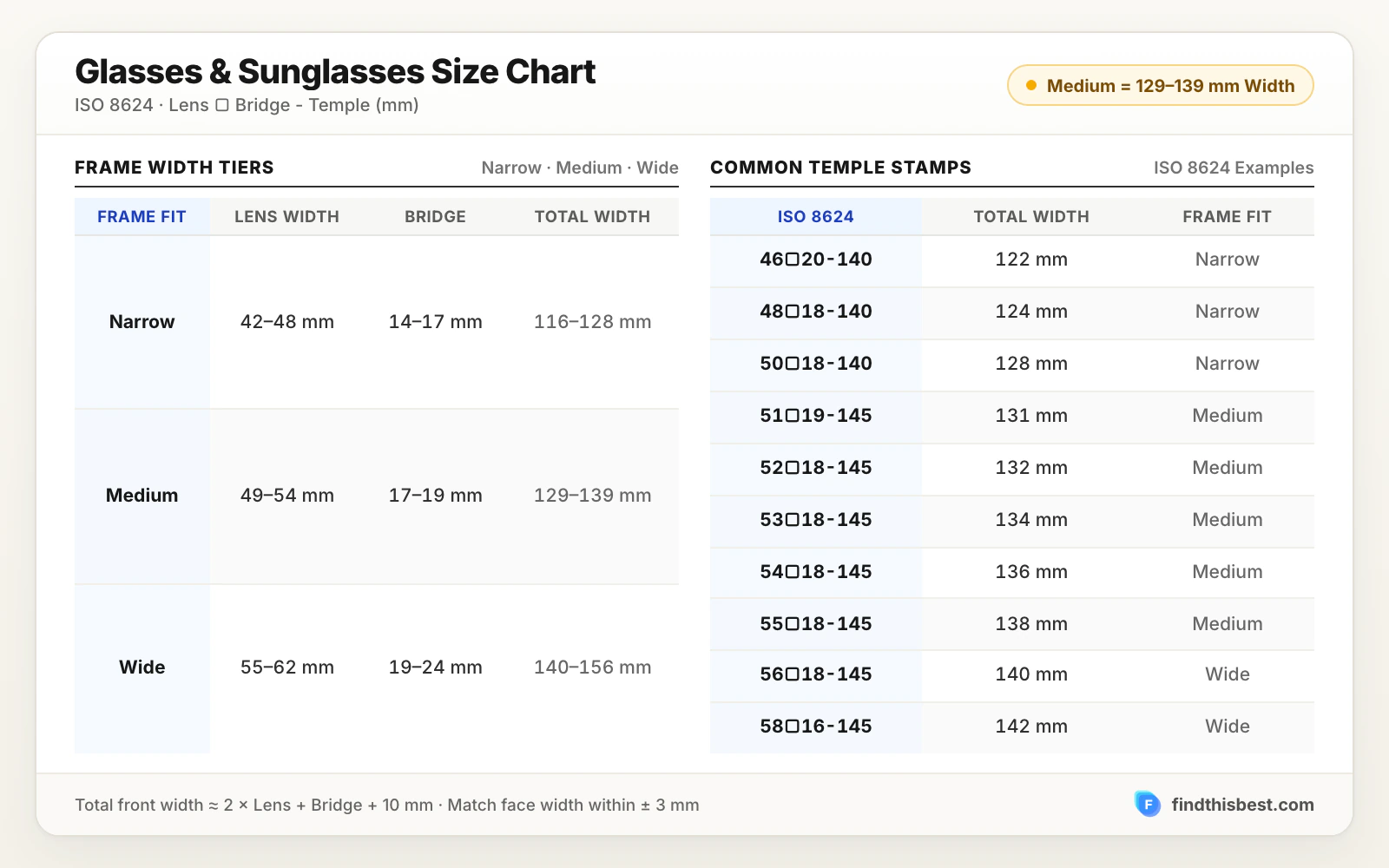
Eyeglasses & Sunglasses Frame Size Chart

Optical frames worldwide follow the ISO 8624 boxing system in millimeters. Use the tables below to translate any temple stamp into Narrow, Medium, or Wide front width.

Frame Fit Lens Width Bridge Temple Total Width
Narrow 42–48 mm 14–17 mm 130–140 mm 116–128 mm (4.6–5.0")
Medium 49–54 mm 17–19 mm 140–145 mm 129–139 mm (5.1–5.5")
Wide 55–62 mm 19–24 mm 145–155 mm 140–156 mm (5.5–6.1")
ISO 8624 Total Width Frame Fit
46□20-140 122 mm Narrow
48□18-140 124 mm Narrow
50□18-140 128 mm Narrow
51□19-145 131 mm Medium
52□18-145 132 mm Medium
53□18-145 134 mm Medium
54□18-145 136 mm Medium
55□18-145 138 mm Medium
56□18-145 140 mm Wide
58□16-145 142 mm Wide
60□17-150 147 mm Wide

Eyewear Shopping Reviews

Compare Frame Fits Across Our Eyewear Brand Reviews

Once you know whether you wear Narrow, Medium, or Wide frames, explore how popular eyewear brands handle sizing, lens options, and returns:

Most adults wear a Medium (129–139 mm total width) frame—such as 52□18-145 (~132 mm) or 55□18-145 (~138 mm on a standard rim). Petite faces typically fit Narrow (≤ 128 mm) frames, while broad faces need Wide (140+ mm) frames so temples never pinch.

Quick-reference chart image

Glasses & Sunglasses Size Chart

ISO 8624 eyewear sizing reference comparing Narrow, Medium, and Wide frame dimensions.

Download PNG

How to Read the Three Numbers on Your Glasses Arm (ISO 8624)

Almost every pair of prescription glasses and quality sunglasses displays three millimeter numbers on the inner left temple arm separated by a square symbol (□) or dashes, such as 52□18-145.

The first number (52 mm) is a single lens width (A) at its widest horizontal point; the second (18 mm) is the bridge width (DBL) across the nose; the third (145 mm) is the temple arm length from hinge to ear tip. Total front width equals approximately 2 × Lens + Bridge + rim allowance (+6 mm for thin titanium/wire, +10 mm for standard frames, or +16 mm for chunky acetate).

How to Measure Your Face Width Without Existing Glasses

  1. 01. Stand facing a mirror and hold a rigid millimeter ruler horizontally just under your eyes, aligned with both temples.
  2. 02. Read the distance from the outer edge of your left cheekbone/temple to the outer edge of your right temple (typically 120–150 mm).
  3. 03. Match your total frame width within ± 3 mm of your temple-to-temple width so the arms rest straight back without splaying outward.

Pupillary Distance (PD), Lens Height (B) & High-Prescription Fit

Two frames with the same front width can feel completely different optically depending on Frame PD (Lens + Bridge) compared with your wearer PD (typically 58–68 mm for adults). Keeping |Frame PD − Wearer PD| ≤ 5 mm places your eyes near the optical center of each lens, minimizing edge thickness and distortion.

If the gap exceeds 8 mm—common when narrow-PD wearers buy oversized 56 mm+ lenses—minus prescriptions (−4.00 D and stronger) gain thick outer edges and minification rings. Also check the unlisted vertical lens height (B measurement): single-vision reading/distance frames work down to 28 mm, whereas progressive / varifocal lenses require at least 30–34 mm of vertical height for smooth distance-to-reading corridors.

Frequently asked questions

Each lens is 52 mm wide, the nose bridge gap is 18 mm, and each temple arm measures 145 mm long—yielding a Medium total front width around 132 mm on a standard frame (+10 mm endpieces).

How this works

Dimensions follow the ISO 8624 optical boxing system (A lens width, DBL distance between lenses, and overall temple length), estimating total front width as 2 × A + DBL + rim allowance (+6 / +10 / +16 mm) and optical Frame PD as A + DBL.

Total front frame width
Adds 2 × lens width (A) + bridge (DBL) + rim/hinge allowance (+6 mm thin wire, +10 mm standard acetate, +16 mm thick/wrap).
Optical Frame PD check
Computes Frame PD = A + DBL and compares against wearer PD (≤ 5 mm ideal, 5.5–8 mm acceptable, > 8 mm caution).
Fit width brackets
Classifies total front width strictly as Narrow (< 129 mm), Medium (129–139 mm), or Wide (≥ 140 mm).
  • Narrow (< 129 mm), Medium (129–139 mm), and Wide (≥ 140 mm) bands classify strictly by total front width.
  • Optical decentration checks |Frame PD − Wearer PD|: ≤ 5 mm ideal, 5.5–8 mm acceptable, > 8 mm high-decentration caution.

Sources & standards

More Sizing & Fit tools

All tools