

SparkFun feature image

SparkFun

Review rating Review rating Review rating Review rating Review rating 4.3 Fact checked

* We independently evaluate all recommended products and services. If you click on links we provide, we may receive compensation.

When purchasing a product, price is the consumer's primary concern. At present, SparkFun has 306 products for sale. SparkFun products range in price from $4.99 to $259.95, and the average price of all the products is about $61.31.

We found that most of the SparkFun products are manufactured by SparkFun Electronics and Alchitry. The manufacturers provide SparkFun with a steady supply of products, and they have a good cooperative relationship with each other.

You can confidently purchase SparkFun products from the seller SparkFun Electronics Inc.. The brand holds an average rating of 4.3, testifying to its excellent reputation.

SparkFun Best Sellers

Last Updated: Jan 10, 2026

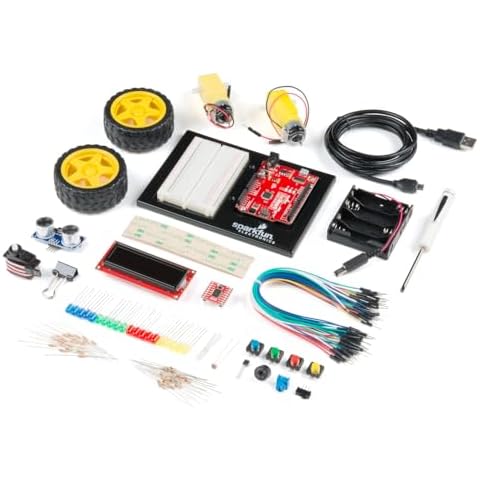
SparkFun Inventor's Kit - v4.1.2 (SIK) RedBoard Qwiic- White Solderless Board- Carrying Case- 16x2 White on Black LCD (with headers) SparkFun Motordriver (with headers)

Complete Kit: A great way to get started with programming and hardware interaction (compatible with) the Arduino programming language
SparkFun Inventor's Kit Guidebook: Finish five overarching projects of 16 interconnected circuits that teach everything from blinking an LED to reading sensors
Includes: SparkFun RedBoard Qwiic, (compatible with) Arduino and Breadboard Holder, White Solderless Breadboard, SparkFun Carrying Case, SparkFun Mini Screwdriver
Also Includes: 16x2 White-on-Black LCD (with headers) SparkFun Motor Driver (with Headers) Pair of Rubber Wheels, Pair of Hobby Gearmotors, Small Servo
Updated Teaching Method: Components introduced in the context of the circuit being built; Each circuit builds upon the last; Leading to a project that incorporates all of the components and concepts introduced throughout the guide

SparkFun Tinker Kit - STEM and STEAM Kit - Learn Compatible with Arduino Programming - 11 Circuits - Blink LED Create Simon Says Game Control a Motor Light Sensor Temperature Sensor and More

The SparkFun Tinker Kit (STK) is a great way to get started with programming and hardware interaction with the compatible with Arduino programming language. This latest version of the STK adds in the Qwiic functionality. Each SparkFun Tinker Kit includes everything you need to complete 11 circuits that will teach you how to blink an LED, read sensors, drive servos, and more.
Includes: SparkFun RedBoard Qwiic; SparkFun Motor Driver (with Headers); Breadboard - Self-Adhesive (White); Servo -- Sub-Micro Size; Hobby Gearmotor -- 200 RPM (Pair); Temperature Sensor -- TMP36; Mini Photocell
Also includes: Pizeo Speaker; Reversible USB A to Reversible Micro-B Cable - 0.8m; Jumper Wires -- 7" M/M 30 AWG (30 Pack); LED - RGB Diffused Common Cathode; Red, Blue, Yellow, and Green LEDs; Red, Blue, Yellow, and Green Buttons
Also includes: Mini Power Switch; 10K Trimpot; Battery Holder - 4xAA to Barrel Jack Connector; 330 and 10K Resistors
Examples: Circuit 1: Blink an LED; Circuit 2: Potentiometer; Circuit 3: Photoresistor; Circuit 4: RGB Night-Light; Circuit 5: Buzzer; Circuit 6: Digital Trumpet; Circuit 7: Simon Says Game; Circuit 8: Servo Motors; Circuit 9: Temperature Sensor; Circuit 10: Motor Basics; Circuit 11: Driving a Motor w/ Inputs

SparkFun Inventor’s Kit for MicroPython - RP2350 IoT RedBoard - 5 Guided Projects (16 Circuits) with Sensors - OLED - Motors - Robot Build - Solderless STEM Kit

Guided learning path: Five projects with 16 step-by-step circuits that teach inputs, outputs, sensing, displays, motion, and a final autonomous robot
Hardware included: RP2350-based SparkFun IoT RedBoard, breadboard/holder, Qwiic 1.3" 128×64 OLED, motor driver, gearmotors and wheels, micro servo, ultrasonic sensor, buttons, LEDs, potentiometer, photoresistor, speaker, resistors, jumper wires, USB-C cable, and accessories
Code in the browser: Project guide uses interactive JupyterLite notebooks for write-and-run MicroPython examples; traditional IDE workflow also supported
Classroom & makerspace ready: No soldering required—plug-and-play circuits on a solderless breadboard with clear build photos and troubleshooting guidance
Designed to expand: Compatible with SparkFun's Qwiic ecosystem for easy I²C sensor/actuator add-ons after completing the included projects

SparkFun Load Cell Amplifier - HX711 Small Breakout Board Read Load Cells to Measure Weight Four-Wire Wheatstone Bridge Configuration Connect to sensors Build Scale Process Control Presence Detection

HX711 IC: Weight items accurately; Note: Some calibration required
Separated analog and digital supply: VCC analog voltage to power the load cell; VDD digital supply voltage used to set the logic level
Two-wire interface (Clock and Data): communication with a microcontroller GPIO pins; Numerous libraries written: for easy-to-read data from the HX711
Operation Voltage: 2.7V--5V: Allows wide range of microcontroller compatibility; Operation Current: < 1.5mA
Connect using Wheatstone bridge configuration: Mostly standard Four-wire connection to load cells; Selectable 10SPS or 80SPS output data rate; Simultaneous 50 and 60Hz supply rejection

SparkFun Logic Level Converter - Bi-Directional Step Down 5V Signals to 3.3V and Steps up 3.3V to 5V Board Dimensions: 0.63 x 0.52 (16.05 x 13.33mm)

The SparkFun bi-directional logic level converter is a small device that safely steps down 5V signals to 3.3V AND steps up 3.3V to 5V at the same time.
The SparkFun bi-directional logic level converter is a small device that safely steps down 5V signals to 3.3V AND steps up 3.3V to 5V at the same time. This level converter also works with 2.8V and 1.8V devices.
The level converter is very easy to use. The board needs to be powered from the two voltages sources (high voltage and low voltage) that your system is using. High voltage (5V for example) to the 'HV' pin, low voltage (3.3V for example) to 'LV', and ground from the system to the 'GND' pin.
What really separates this Logic level converter from our previous versions is that you can successfully set your high and low voltages and step up and down between them safely on the same channel.
Each level converter has the capability of converting 4 pins on the high side to 4 pins on the low side with two inputs and two outputs provided for each side. Board Dimensions: 0.63 x 0.52" (16.05 x 13.33mm)

SparkFun Qwiic Pocket Development Board - ESP32-C6 Mini-1 Module, Including a USB-C Connector, Qwiic Connector, 2-pin JST Battery Connector, Board Dimensions: (Inches) 1" x 1"

The SparkFun ESP32-C6 Pocket Dev Board is built around a RISC-V single-core processor with 4 MB flash memory in a 1"x1" Qwiic Standard Footprint!
It features the ESP32-C6 Mini-1 module. We designed this board with components on both sides of the PCB to squeeze as many features as possible into its tiny footprint, including a USB-C connector, Qwiic connector, 2-pin JST battery connector with an on-board charging circuit, as well as two buttons for Reset and Boot. The design also works to optimize power consumption.
Features: Up to 7 12-bit ADC Channels, Up to 2 UART Channels (with flow control) USB Serial, One Low Power UART Channel, One I2C Channel, One Low Power I2C Channel, LED PWM, One I2S Channel, 4 MB Flash.
Also features: PCB Antenna, Matter-compatible, Qwiic Form-Factor, Dimensions: 1" x 1", Four Mounting Holes, 8 PTH pins, USB-C Connector, 2-pin JST Connector for LiPo Battery (not included) 4-pin Qwiic Connector.
Though some are tied to specific pins, many of these peripherals can be mapped to any GPIO pin. Due to the board's size, it only breaks out eight total GPIO pins, including four ADC-compatible pins, Low Power and Standard UART, and an extra two GPIO pins. All Qwiic-enabled boards use a common 1mm pitch, 4-pin JST connector. This reduces the amount of required PCB space, and polarized connections mean you can't hook it up wrong.

SparkFun 16x2 SerLCD, RGB Text, Qwiic; Red, Green, Blue Text on Black Display, 3.3v Logic & Power

16x2, RGB on Black Display. Three communication options: Serial, I2C and SPI. Adjustable I2C address controlled via software special commands (0x72 default). Qwiic connection.
The AVR ATMega328p (with compatible with Arduino bootloader) is populated on the back of each LCD screen and handles all of the LCD control. Open-sourced firmware and compatible with Arduino bootloader enables updates via the IDE
Emergency reset to factory settings (Jumper RX to GND on bootup). Operational backspace character. Incoming buffer stores up to 80 characters
Pulse width modulation of backlight allows direct control of backlight brightness and current consumption. Pulse width modulation of contrast allows for software-defined contrast amount.
User-definable splash screen. Dimensions (LxWxH): 80.02x36.13x14.27mm. Weight: 0.0779 oz.

SparkFun Serial Basic Breakout - CH340C and USB-C Development Tool Save Space and Money in Your DIY Electronics Projects

USB-to-Serial adapter with handy USB-C Connector: Three times power delivery over the previous USB generation at 1.5A; Faster connection
Works with 5V and 3.3V systems: Output Jumper Included; Switch from 3.3V to 5V signals on VCC pin
No Additional Drivers Required: Auto install on most operating systems
Serial basic pinout: Mimics common DTR/RXI/TXO/VCC/CTS/GND pinout found on hundreds of FTDI-to-USB derivatives
Note: Can also be used for debugging (such as with a GPS module)

SparkFun Sound Detector Audio Sensing Breakout Three Different outputs Audio Presence of Sound Binary Indication Amplitude Analog Representation VCC: 3.5V to 5.5V Ideal Voltage is 5V

Three independent outputs: The SparkFun Sound Detector provides three outputs—audio, binary sound detection, and analog amplitude—allowing you to use any combination of them simultaneously
Envelope output for amplitude measurement: Easily read the amplitude of sound by measuring the analog voltage from the envelope output pin
Adjustable gain: Gain can be modified using a through-hole resistor, which also adjusts the threshold for the binary (gate) output pin
Simple pin-out connection: The three output signals are accessible on a .1" pin-out at the edge of the board and are active simultaneously
Flexibility in usage: If a particular output is not needed, simply leave the corresponding pin disconnected while still using the others

SparkFun Thing Plus - ESP32 WROOM (USB-C) - ESP32-D0WDQ6 Chip Integrated RGB Status LED Operating Voltage: 3.3V Board Dimensions: 2.3in x 1.0in x 0.5in

The USB-C variant of ESP32 Thing Plus is a development board with WiFi, SPP, BLE, Qwiic connector, 21 I/O pins, RGB status LED, and micro SD card slot.
ThingPlus ESP32-WROOM Features: 21 Multifunctional GPIO. Up to thirteen 12-bit ADC Channels. Up to two DAC channels. Up to sixteen PWM outputs. Up to eight capacitive touch pins. Up to three SPI Busses (only one is configured by default in the Arduino IDE)
Also Features: An available I2S Audio Output. Up to two I2C Busses (only one is configured by default in the Arduino IDE) Up to two UARTs (only two are configured by default in the Arduino IDE, one UART is used for bootloading/debug)
Thing Plus (or Feather) Form-Factor: Dimensions: 2.55" x 0.9". Four Mounting Holes: 4-40 screw compatible. 28 PTH Pins. USB-C Connector.
The ESP32 Thing plus integrates a rich set of peripherals, ranging from capacitive touch sensors, Hall sensors, SD card interface, Ethernet, high-speed SPI, UART, I2S and I2C, etc. The module also features 16MB of flash memory, 520kB of internal SRAM, an integrated 802.11 b/g/n WiFi transceiver.

SparkFun RedBoard Qwiic ATMega328P Compatible with Arduino Board w/Qwiic Connector and CH340C Serial-USB Converter IC Breadboardable R3 Footprint microcontroller Improved Reset Button

ATmega328 microcontroller with Optiboot (UNO) Bootloader. Rev3 shield compatible.
Program with a USB Micro-B cable using the Arduino IDE platform: Plug in the board, select “Arduino UNO” and you're ready to upload code
Hardware peripherals you know and love: 20 Digital I/O pins with 6 PWM pins, 6 Analog Inputs, UART, SPI and external interrupts
Broken out the SDA, SCL and IOREF pins, so it will be compatible with future shields Power over USB or through the barrel jack 7 to 15VDC
The SparkFun Qwiic Connect System is an ecosystem of I2C sensors, actuators, shields and cables that make prototyping faster and less prone to error. All Qwiic-enabled boards use a common 1mm pitch, 4-pin JST connector. This reduces the amount of required PCB space, and polarized connections mean you can't hook it up wrong.

SparkFun 9DoF IMU Breakout-ICM-20948 Low Power I2C & SPI Enabled 9 axis Motion Tracking Includes Logic Shifter Qwiic Connection GPIO pins Digital Motion Processor Accelerometer Gyroscope Magnetometer

9DoF IMU Breakout: This breakout board is Qwiic enabled, complete with a logic shifter and broken out GPIO pins for all motion sensing needs
Features: 1.95 V to 3.6 V supply voltage, Triple-axis MEMS gyroscope, user-programmable full-scale range ±250 dps to ±2000 dps, Triple-axis MEMS accelerometer programmable full scale range from ±2g to 16g, Triple-axis silicon monolithic Hall-effect magnetic sensor with full scale measurement range
3-Axis Gyroscope, 3-Axis Accelerometer and a 3-axis magnetometer The gyroscope and accelerometer both have four selectable ranges, and the magnetometer with a FSR to ±4900µT
The breakout also includes a Digital Motion Processor for offloading the computation of motion sensing algorithms and allowing optimal performance of the sensors, Broken out ICM-20948 pin: For increased functionality to GPIO, we've also labled them I2C on the front, SPI on the back for ease of identification
Note : The I2C address of the ICM-20948 is 0x69 and is jumper selectable to 0x68. A multiplexer/Mux is required to communicate to multiple ICM-20948 sensors on a single bus. If you need to use more than one ICM-20948 sensor consider using the Qwiic Mux Breakout.

SparkFun Optical Tracking Odometry Sensor - PAA5160E1 (Qwiic) - Optical Tracking Sensor - Included 6-Axis IMU - 1 in x 1 Dimensions

High-Speed Motion Tracking: 2.5 meters per second: For fast speed applications
Smaller profile: 1 inch x 1 inch footprint single-board design
Integrated microcontroller STM32: Arm 32-bit Cortex-M0+ CPU; frequency up to 48 MHz; -40°C to 85°C/105°C/125°C operating temperature; Up to 32 Kbytes of flash memory with protection; I2C address: 0x17 (fixed); Real-time sensor fusion and tracking algorithms
Optical Tracking Sensor - PAA5160: Tracking Accuracy: 3-5%; Tracking speed: 2.5m/s; Working Distance to Tracking Surface: 10-27mm; Frame Rate: 20,000 fps
Incorporated 6-DOF IMU Accelerometer: ±2/±4/±8/±16 g full scale; ±125/±250/±500/±1000/±2000 dps full scale

SparkFun Digital Temperature Sensor - TMP102 (Qwiic)-Compatible with Arduino and other Single-board computers Easy-to-Use I2C sensor Plug-and-Play breakout board Runs from 1.4-3.6V input Use with 3.3V

Uses the I2C interface. I2C Address: 0x48 by default (Three additional addresses available, as well). 12-bit, 0.0625°C resolution. Typical temperature accuracy of ±0.5°C
3.3V sensor. Supports up to four TMP102 sensors on the I2C bus at a time. 2x Qwiic Connectors
The breakout has built-in 4.7kΩ pull-up resistors for I2C communications and runs from 1.4V to 3.6V.
I2C communication uses an open drain signaling, so there is no need to use level shifting.
The alert pin is an over temperature alert, which has an open-drain and is pulled up through a 10kΩ resistor. The alert can also be read over I2C

SparkFun GPS-RTK2 Board - ZED-F9P (Qwiic) High-Precision Breakout No Soldering Required Breadboardable Contains a Rechargeable Backup Battery Allowing a Warm-Start decreasing time-to-First-fix

Dual operations: Capable of 10mm, three-dimensional accuracy; Both rover and base station operations
Multiple configuration options: Geofencing; Variable I2C address; Variable update rates; even the high precision RTK solution can be increased to 20Hz
Five communications ports which are all active simultaneously:USB-C (which enumerates as a COM port); UART1 (with 3.3V TTL): UART2 for RTCM reception (with 3.3V TTL); I2C (via the two Qwiic connnectors or broken out pins); SPI
Compatible with Arduino library: Read latitude, longitude, heading and speed over I2C without the need for constant serial polling; Time to First Fix: 25s (cold), 2s (hot)
Note: GPS board only; Does not come with cables or microcontroller

SparkFun RFID Qwiic Reader-Pairs with The ID-LA modules: ID-3LA, The ID-12LA, or The ID-20LA, and utilizes 125kHz RFID Chips Includes Read LED & Buzzer No Soldering Required

The Qwiic RFID ID-XXLA is an I2C solution that pairs with the ID-LA modules: ID-3LA, the ID-12LA, or the ID-20LA, and utilizes 125kHz RFID chips.
Simply plug a reader into the headers and use a Qwiic cable, then scan your 125kHz ID tag and the unique 32-bit ID will be shown on the screen.
The unit comes with a read LED and buzzer, but don't worry, there is a jumper you can cut to disable the buzzer if you want.
Utilizing our handy Qwiic system, no soldering is required to connect it to the rest of your system. However, we still have broken out 0.1"-spaced pins in case you prefer to use a breadboard.
Note: This product does not come with the RFID reader or tags.

SparkFun Spectral UV Sensor - AS7331 (Qwiic) -Four Operating Modes, High Dynamic Range: Up to 3.43E+10 (Resolution multiplied by gain Range) Operating Voltage: 2.7V-3.6V, Dimensions: 1.0in x 1.0in

The SparkFun AS7331 Qwiic Spectral UV Sensor measures UV radiation on three channels, UVA, UVB, and UVC, with high sensitivity and accuracy.
Features: Operating Voltage: 2.7V-3.6V, Current Consumption: Active Measurement: 1.42mA (Typ.) Standby Mode: 970µA, Power Down Mode: 1µA.
Also features: Three UV Channels: UVA, UVB, & UVC, Each with dedicated photodiode, Four Operating Modes: Single Measurement, Continuous Measurement, Synchronized Start Measurement, Synchronized Start/Stop Measurement, High Dynamic Range: Up to 3.43E+10 (resolution multiplied by gain range) 2x Qwiic Connectors.
The AS7331 communicates over I2C, so naturally, this breakout routes the I2C bus pins (3.3V, GND, SDA, and SCL) to a pair of Qwiic connectors on each side of the board for solderless assembly but also routes them to a 0.1in.-spaced through-hole header on the bottom of the board for users who prefer a soldered connection.
The SparkFun Qwiic Connect System is an ecosystem of I2C sensors, actuators, shields and cables that make prototyping faster and less prone to error. All Qwiic-enabled boards use a common 1mm pitch, 4-pin JST connector. This reduces the amount of required PCB space, and polarized connections mean you can't hook it up wrong.

SparkFun Qwiic Mux Breakout - 8 Channel (TCA9548A) - Easily Read Multiple sensors with The Same I2C Address Or Communicate with Multiple I2C Devices with Different addresses - Board only

Do you have too many sensors with the same I2C address? Put them on the SparkFun Qwiic Mux Breakout to get them all talking on the same bus!
The Qwiic Mux also has eight configurable addresses of its own, allowing for up to 64 I2C buses on a connection. Also allows you to change the last three bits of the address byte, allowing for eight jumper selectable addresses if you happen to need to put more than one Qwiic Mux Breakout on the same I2C port.
All Qwiic-enabled boards use a common 1mm pitch, 4-pin JST connector. This reduces the amount of required PCB space, and polarized connections mean you can't hook it up wrong.
Operating Voltage: 1.65V - 5.5V. Operating Temperature: -40 - 85° C. I2C Address: 0x70 (default) up to 0x77.
10x Qwiic Connectors: 2x Pass Through (Daisy Chain), 8x Channels

SparkFun Inventors Kit v4.1 for Arduino Uno (SIK) Beginner Kit Start Learning Programming and Electronics No Soldering

Starter Kit to Learn Arduino Programming: No previous programming or electronics experience required
Includes the Arduino Uno: All parts are usable for your own projects once you complete the kit
Complete 16 exciting projects: Including a Simon Says Game and Autonomous Robot
Learn the Basics: Experiment with Light, Sound, Motion, Displays, Sensors, and Robots; Basics of electronics and build the knowledge to start creating your own projects
Instructions available online: This SIK does NOT include a carrying case or print guidebook

SparkFun GPS-RTK-SMA Breakout-ZED-F9P (Qwiic)-Concurrent reception of GPS GLONASS Galileo BeiDou High precision GPS 10mm 3 dimensional accuracy Receives L1C/A & L2C bands Voltage:5V or 3.3V Logic:3.3V

Concurrent reception of GPS, GLONASS, Galileo and BeiDou. Receives both L1C/A and L2C bands, Time to First Fix: 25s (cold), 2s (hot)
Voltage: 5V or 3.3V but all logic is 3.3V. Current: 68mA - 130mA (varies with constellations and tracking state). Weight: 6.8g. Dimensions: 43.5mm x 43.2mm (1.71in x 1.7in). 2x Qwiic Connectors
This product is compatible with u-blox PointPerfect. Take your precision to the next level with the PointPerfect GNSS augmentation service.
Max Navigation Rate: PVT (basic location over UBX binary protocol) - 25Hz. RTK - 20Hz. Raw - 25Hz
Horizontal Position Accuracy: 2.5m without RTK. 0.010m with RTK. Max Altitude: 50km (31 miles). Max Velocity: 500m/s (1118mph)

SparkFun FAQs

Yes, SparkFun is a legitmate brand on Amazon. After conducting a comprehensive analysis of 416 customer reviews for SparkFun products on Amazon, we have determined its average rating. Offering great value and satisfying quality, SparkFun has achieved a respectable rating of 4.3 from many customers, showing that its products meet customer expectations. While there may have been minor issues reported occasionally, overall, it is safe to make purchases from SparkFun on Amazon.

Amazon has strict policies and safety measures in place that ensure only legitimate sellers and products are allowed on their platform. It also provides a secure payment gateway and offers buyer protection, ensuring your transaction is safe. In the unlikely event that there's an issue with your purchase, Amazon's customer service and return policies are designed to protect your interests.

If you're interested in SparkFun and want to find more SparkFun products, you can follow the steps below:

  1. Go back to FindThisBest's homepage.
  2. Type SparkFun in the search box and hit Enter to see the search results.
  3. Find and click the correct SparkFun to go to the new page.
  4. Select the products you want in the SparkFun buying guide, and take a glance at the prices and features of the products.
  5. View the products interest you on Amazon to read the customer reviews and check the ratings. Besides, you can hit the "brand" to find more SparkFun products.

We analyze millions of SparkFun products reviews and customer reviews to recommend the best picks for most consumers. We have a professional team with decades of experience to test the products, which can help ensure that we provide our readers with accurate advice and best recommendations.

There are usually 5 to 10 products in a brand buying guide. We found 306 SparkFun products for sale, 20 of which were analyzed in detail and recommended to customers.

  1. Go to the SparkFun page.
  2. Select the product you want in the SparkFun buying guide, and then view the product on Amazon. For example, if you are interested in the top 1 product SparkFun Inventor's Kit - v4.1.2 (SIK) RedBoard Qw..., you can view it on Amazon page.
  3. Place your order on Amazon.

Most of the SparkFun products are produced by SparkFun Electronics and Alchitry. The manufacturers provide SparkFun with a steady supply of products, and they have a good cooperative relationship with each other.

Our mission is to provide you with the most up-to-date and objective information about the SparkFun products, helping you make more informed buying decisions. We recommend best choices of the products from the SparkFun brand, helping you make better shopping choices with less time and energy.