Biaggi is a useful place to browse when luggage storage at home is the problem you want to solve. We’d start with its Zipsak range for a bag that packs away between trips. The important choice comes before color: do you want a light, soft bag with fabric handles, or a suitcase with a telescoping trolley handle? Biaggi sells different designs, and those ways of carrying and rolling a bag should not be treated as interchangeable.
Compare fold-away bags by their stored size and how you will carry or roll them. Handle types differ across models.
Browse Zipsak bagsStart with the space where you will put it away
The Zipsak Boost! Underseater Expands To Carry-On is a good example of the storage idea. Biaggi lists a folded size of 15 × 9 × 4 inches. Look at the shelf, drawer or space beneath the bed where you would keep it. Leaving an empty conventional suitcase in that spot may consume much more room than the trips themselves justify.
The same product is listed at 16 × 15 × 9 inches before expansion and 21 × 15 × 9 inches expanded, at 3.85 pounds. Think of those as two packing configurations of one bag. Opening the expansion changes what you can pack and the space the bag needs on the journey. Boost dimensions
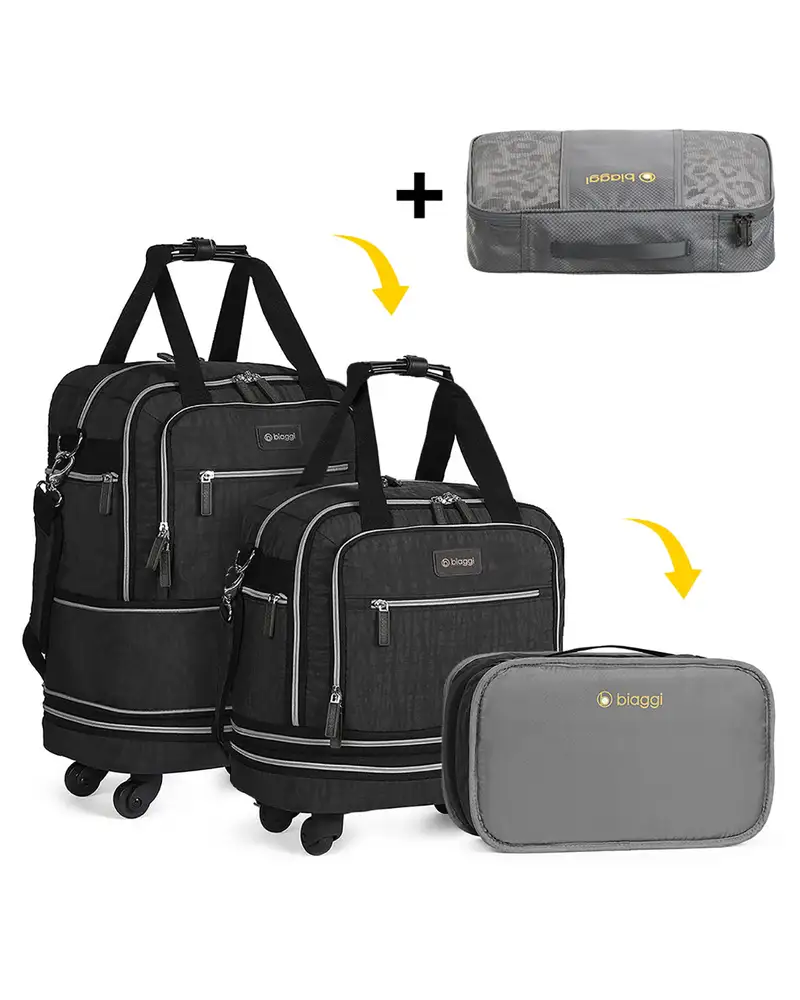
Black version pictured. Soft handles, four spinner wheels and an included packing cube; compare folded and expanded measurements before ordering.
See this Boost configurationThe merchant photograph shows both configurations, a folded bag and the included packing cube. It does not mean two wheeled bags are included. Read the selected item and quantity in the cart. Bundles elsewhere in the shop may have different contents, even when the photographs use several related pieces together.
The fabric handle is a buying decision
This Boost version has four spinner wheels, fabric carry handles and an adjustable shoulder strap. It does not have the rigid telescoping handle found on a conventional spinner. That matters when imagining how you will move through a terminal with the bag loaded.
If a telescoping handle is essential, compare the shop’s trolley-luggage collection and read the specifications of the exact bag there. Do not buy this soft-handle Boost because a different Biaggi model, an older listing or a similar product photograph shows a trolley handle. We have not rolled a loaded Boost, so we would not promise its handling from a product video or the wheel count alone.
The shoulder strap gives you another way to carry this model, but it also puts the packed weight on your body. Picture the stairs, train connection and walking distance on your usual trip. The storage advantage is most useful when the carrying arrangement also fits that trip.
Check your flight against the bag you will actually pack
“Underseater” and “carry-on” are product descriptions, not permission to bring a bag on every fare. Compare the bag’s selected configuration with the current allowance for your booked airline and ticket. Confirm whether the quoted dimensions include the wheels and handles before relying on a close match.
We’d make that comparison before deciding to expand it for the return journey. A bag that suited the outbound allowance can become a different size once you add souvenirs. Soft fabric does not make an overfilled bag smaller than the things inside it. If the allowance is tight, use a bag with a clearly suitable outside measurement and leave room for packing variation.
A backpack may be the simpler second piece
For a light personal bag rather than wheeled luggage, compare the Zipsak On-The-Go Backpack. Biaggi lists it at 16 × 12.5 × 7 inches and 1.4 pounds, with a trolley sleeve and a folded size of 12.5 × 6.5 × 3 inches. It is a different purchase: carrying on your back instead of relying on wheels and a soft pulling strap.
We’d choose between those jobs first. A backpack may be useful over the handle of a main suitcase, while a wheeled Boost may be intended as your main light bag. Before buying a set, lay out what goes in each piece and check the combined baggage rules for the journey. A matching color is not a reason to pay for a second bag you will leave at home.
Check the fold and handles before the first trip
Biaggi’s direct-store return policy gives 45 days from purchase and requires brand-new condition and original product packaging. That starts earlier than a deadline measured from delivery. We’d unpack promptly, check the seams, zippers, included pieces and folding instructions, and keep all packaging while deciding whether to keep it.
Return-label costs depend on the US return-protection option chosen at checkout. Without it, the policy lists a flat label fee; manufacturer defects and warranty claims have a separate process through customer service. Read that choice in the final order instead of relying on a general “free returns” banner.
We’d choose Biaggi when a fold-away bag solves a real storage problem and the exact handle arrangement suits the trip. If you want a familiar rigid-handle spinner above all else, make that your starting requirement and compare those models directly.
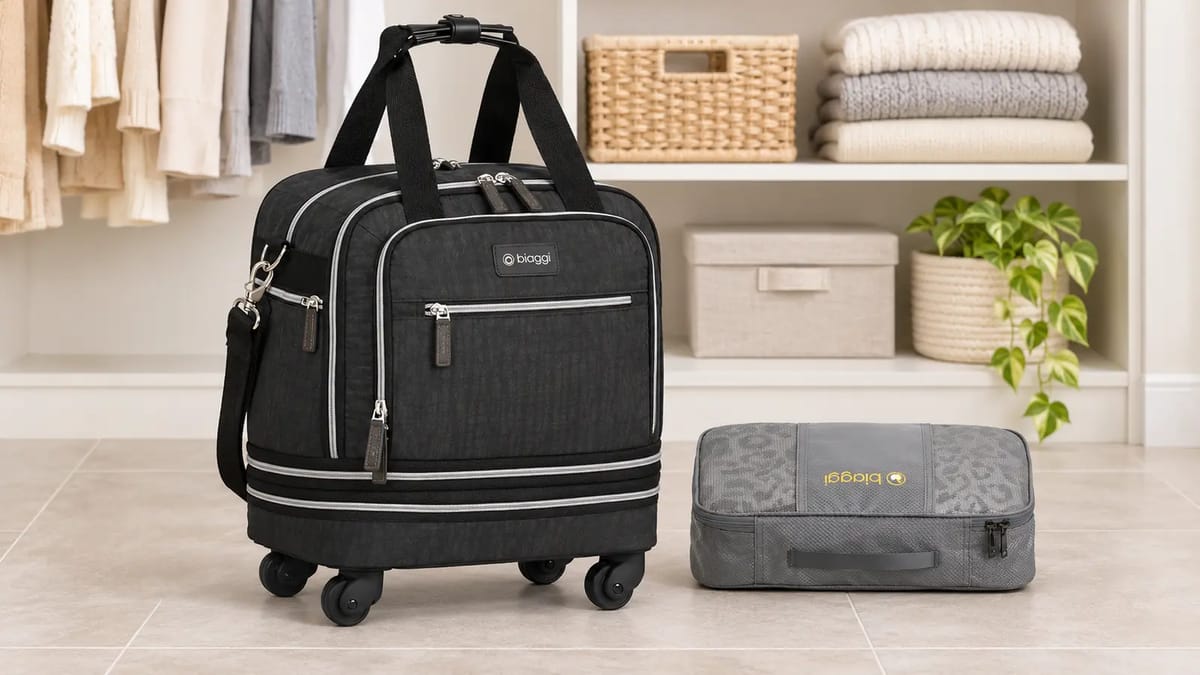
US product and direct-store return pages reviewed November 20, 2026. This guide uses published specifications, without a packing, rolling or airline-fit test. Cover is an editorial reconstruction of the black Boost with its included packing cube; the product card uses the merchant’s configuration photograph.